

It has been a while since Paul Greenberg put the stake in the ground by writing down the definition of Social CRM. For further reading purposes I will repeat it here:
SCRM is a philosophy & a business strategy, supported by a technology platform, business rules, workflow, processes & social characteristics, designed to engage the customer in a collaborative conversation in order to provide mutually beneficial value in a trusted & transparent business environment. It’s the company’s response to the customer’s ownership of the conversation.
On top of the definition I think there is a more specified set of elements needed to define a Social CRM strategic framework statement. A statement that can provide some direction how to design processes, services and experiences in line with the SCRM philosophy and the latest thinking on Customer Centricity and CRM.
I think of strategy in 3 simple questions: Who are your Customers? What are their needs? How will those needs be met? Answering these questions will provide you with a rough strategic statement that enables you to communicate both internally and externally on what your Company is all about. At the end of this post I will provide you with my view on the Strategic Framework Statement for Social CRM.
Before I do I will take you through some steps I think are important for understanding the framework-statement I propose. First of all we need to understand how Social CRM changes the way we answer those 3 questions? What has changed through Social CRM, with regard to the strategic framework that is significantly different from the pre-scrm era?
Paul Greenberg makes a statement in his “staking”-post that relates to this last question, which I totally agree with:
What this means is that SCRM is an extension of CRM, not a replacement for CRM. Its a dramatic change in what it adds to the features, functions and characteristics of CRM but it is still based on the time honored principle that a business needs its customers and prefers them profitable and that same business needs to run itself effectively too.
But there is a change! Another quote from Paul Greenberg:
The lesson for business, in terms of Social CRM is that we are now at a point that the customers’ expectations are so great and their demands so empowered that our SCRM business strategy needs to be built around collaboration and customer engagement, not traditional operational customer management“
This is the fundamental change, that has been discussed and is still being discussed all over the (virtual) globe.
On top of this Graham Hill said the following in a comment to Paul Greenberg’s post:
Social CRM […] extends CRM from being something predominantly inside-out, to something that extends out into the conversations that customers are having between themselves. If we want to engage customers we need to really understand […] the jobs customers are trying to do and the outcomes they are trying to achieve by doing them. This is best practice in understanding customer needs today […] Once we understand what customers need, we can innovate around delivering exactly that […]. And we can use service-dominant logic to provide experience platforms that allow customers to co-create value together with companies. Co-creating value with customers is the modern definition of customer-centricity.
This is not a light read and Graham Hill has since written several posts that shed some more light on the value co-creation concept. I wrote a post on the definition of Value Co-creation myself based on (among other) Graham Hill’s views (you can find links to his post there) because I had a need myself to better grasp the concept of value co-creation and furthermore because I felt the need to be able to explain it in as few words as possible to anyone who is newly introduced to the concept.
I advise you to read the whole post as well as the comments on it. This has been one of the most valuable posts for myself when it comes to better understanding the concept of value co-creation and the way it differs from different shades of “co-production” or “mass-customization” (the differentiating element is `personalization of experiences – in use`). To Conclude, my personal definition of value co-creation:
Value is Co-created with Customers if and when a Customer is able to personalize his Experiences through a product or service – in the lifetime of its use – to a level that is best suited to get his job(s) done.
If I now take the definition of Social CRM from Paul Greenberg, the understanding of Service Dominant Logic, Customer jobs and desired outcomes as explained by Graham Hill as well as the differentiating element from the value co-creation definition, and I put them all together in context by answering the who-what-how questions, I get what I would like to define as the Social CRM strategic framework-statement:
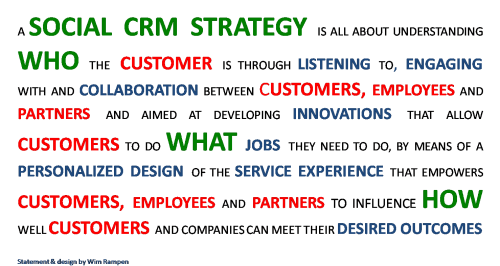
Obviously I like it and I will discuss in future posts what I think the implications of this statement are for a more detailed strategy.
Of course I am not a guru and I’m definitely not perfect in what I think and write. So it is now up to you all to blow it to bits or otherwise let me know what you like or not about the statement. And I would appreciate any views on the implications of the SCRM strategy framework statement when it comes to building a detailed strategy.
Thx for stopping by, reading and letting me know your thoughts.