

Knowing whom to call and precisely when to call is the Holy Grail of B2B marketing and sales today. A good friend, Craig Elias, has written the definitive book on Trigger Events, Shift. And another good friend, Bob Apollo of Inflection Point wrote a great article called Trigger Event Marketing.
Trigger events are things happening on the buyer side which make them stand up and take notice. Let’s say they hire a new VP of Sales and he needs to expand the sales team, and you are a headhunter. Perfect time to call him.
InTouch and Brian Carroll produced a nice graphical display in their article,
The Physics of Trigger Events for Lead Generation
with all your options on trigger events. I share it here. Click on the image to expand it.
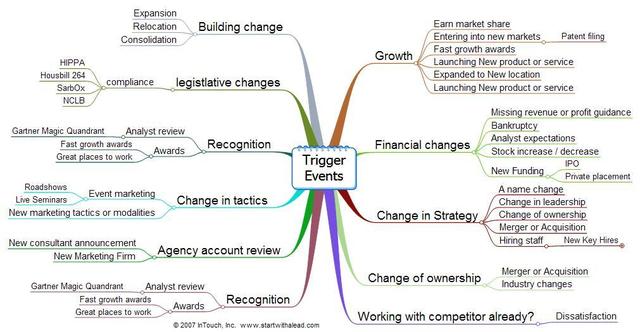
Knowing exactly when to call and what to say is a very valuable asset in B2B sales and marketing today.
Google Alerts, InsideView and iSell by our former client, OneSource, are three products that alert you to trigger events. (Please note: The B2B Sales Lounge used to post daily when we managed it, now it posts only 2-3 times a month.)
What do you think about Trigger Events? Do you use them? What kind of results have you seen? We love your comments.



. . . but my experience has been that the forces that create them have been in play way before the trigger event triggered. I’ve railed on the risks of trigger-event following for a long time. Triggers are addictive, because almost every salesperson has notched a sale or two for being in the right place at the right time. I have, too. Are triggers precursors for purchases? You betcha! But do you want to base your sales strategy on being an ambulance chaser? Not me, because my trend-watching competitors have eaten my lunch more than I’d like to admit. They already established a relationship with my prospect before I even knew there was a problem.
While many CEO’s manage by going from crisis to crisis (you’ll find plenty of salespeople following them, like a flock of sheep), there are many who are driven to buying things by other business challenges, like revenue growth and cost reduction. Find any triggers there? Me neither.
In your example, how many other headhunters have just called the newly-hired VP of Sales? Anyone who has Google Alerts. Take a number, and get in line, because at that point you’re just another opportunistic “me-too” vendor, even if you think you’re truly different. I’m not sure if there is such a thing as “the perfect time to call,” but a motivated competitor might have gotten cozy with that company’s CFO six months earlier, while holding a C-Level discussion over drinks about the connection between sales force churn and cash-flow management.
An article I wrote on the topic takes might be of interest to your readers: Are Salespeople Trigger Event Happy?
I wished to congratulate both men for talking a potentially explosive disagreement and turning into an intelligent point/counterpoint discussion. Andrews post brings up so concerns with trigger events, but Craig, the top expert on trigger events, writes an eloquent rebuttal.
Great job by both men!
Jeff Ogden, the Fearless Competitor
Find New Customers
http://www.findnewcustomers.com
Since it’s obvious that Andrew’s comment was written to create controversy and generate conversation I’m going to say "Thank you Andrew for tossing me a soft ball:
Andrew’s comments miss the point on sooooooooo many different fronts I can’t count them but let me give you the first five:
1) He’s looking at the wrong Trigger Events.
When you are out there selling Trigger Events put people into one of three different buying modes:
Status Quo
There has not been a Trigger Event in the recent past so the buyer is completely happy with what he or she currently has.
Window of Dissatisfaction™
A Trigger Event has recently taken place and this buyer knows that what they are currently using is no longer sufficient, but has not done anything about it yet.
Searching For Alternatives
A Trigger Event took place a while ago, and they’ve already taken action on it.
People move between these three buying modes depending on the types of Trigger Event they experience.
Want: Something has happened to my current provider or me that makes me want to change. These events shift people from Status Quo into the Window of Dissatisfaction™.
Afford: Something has happened that gives me either the time or money to change. These events shift people from the Window of Dissatisfaction™ into Searching for Alternatives.
Justify: These events allow people to justify their decision to their superior, subordinates, shareholders (and sometimes spouse). These events shift people from Searching for Alternatives into a new Status Quo because now they become your customer.
The follow on events that allow people to afford to change or justify the change can aid in the selling process but it’s important to get there before the competition just after the first event that makes them want to change – so you can define the problem, design the solution, and start developing the relationship.
2) People don’t buy based up on a circumstance of having business challenges, like revenue growth and cost reduction. They buy when something (a Trigger Event) causes it to become a high priority.
Andrew says “Find any triggers there? Me neither.” I didn’t either and that’s why THESE PEOPLE AREN’T BUYING.
You’ve probably got a ton of prospects with the circumstances that Andrew talks about but I think the real question is why aren’t they buying?
They’re not buying because they have not experienced a Trigger Event that makes this circumstance one of their top priorities and something that is a high priority is getting their time, attention, and money.
3) Knowing something and doing something about it are two different things. As Ray Croc (the founder of McDonalds) says ” The two most important requirements for major success are: first, being in the right place at the right time, and second, doing something about it.”
So far my experience is that only the savviest of sales professionals are on the Trigger Event Selling gravy train so his assumption that a ton of people are going to call is flawed in three ways.
a) Everyone does not know of the event
b) Not everyone who knows of the event follows up on the event.
c) Few if any of those who bother to follow up sell the same thing you do
4) One Trigger Event often creates multiple opportunities the savvy sales professionals that are harnessing Trigger Events to TURN PROSPECTS INTO CUSTOMERS are following the additional opportunities.
For example a change in one executive is THREE DIFFERENT OPPORTUNITIES:
Each of these executives are new in their job and have been brought in to make change happen.
They want to make change happen fast AND very often they have NO TIES TO THE PREVIOUS VENDOR. Executives new in their jobs are up to 10 times more likely to change suppliers than their predecessor.
5) Just using publicly available information to find Trigger Events is a huge mistake. There are a ton of ways to learn of Trigger Events that aren’t public. Here is my favourite one – a bounced email …..
In your team’s efforts to keep their prospect list clean, does a bounced email, or a returned piece of direct mail, trigger them to delete this person from their lists?
If so, you are missing one of the biggest opportunities to increase sales.
These people just changed jobs and as mentioned above are now 10 TIMES MORE LIKELY TO BECOME YOUR CUSTOMER
Feel free to call/text me (+1.403.874.2998) if you want to talk about some of the other ways Andrew’s statement misses the mark.